If you’ve ever typed “logo designer near me” into Google at 11 PM while trying to finalise your visiting cards before a print deadline, you already know how overwhelming this decision can feel. Every second freelancer on Instagram claims to be a “brand expert,” every agency promises “unlimited revisions,” and somehow the prices range anywhere from ₹500 to ₹50,000 for what looks, on the surface, like the exact same service.
Here’s the thing — your logo isn’t just a nice picture. It’s what goes on your shop signboard in Malviya Nagar, your packaging if you’re selling out of Johri Bazar, your Instagram grid, your invoices, and eventually, if things go well, your trademark application. Get it wrong, and you’re not just stuck with an ugly design — you’re stuck redoing your entire brand identity six months later, which costs far more than getting it right the first time.
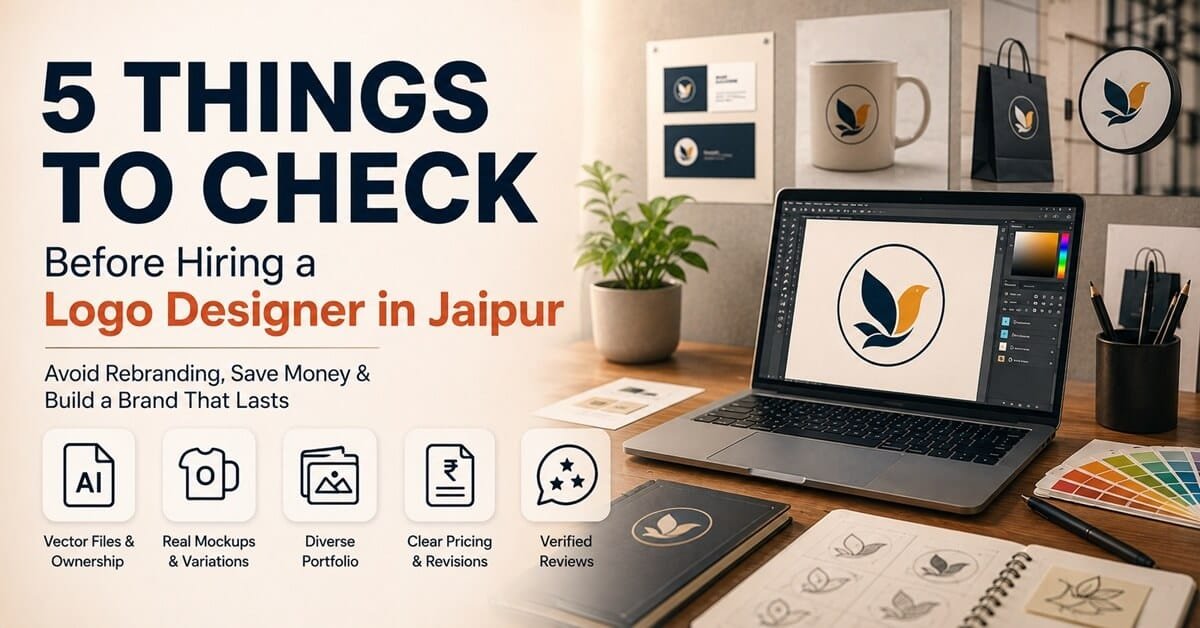
Before you pay that advance or sign that contract, run through these five checks. They’ll save you money, save you a rebrand headache, and help you spot the difference between a designer who actually knows what they’re doing and one who’s just good at marketing themselves.
Ask About Vector Files — Not Just a “Final Logo”
This is the one people skip and regret the most. A lot of budget design services will hand you a PNG or JPEG file, call the project done, and move on. That’s fine if all you ever plan to do is post the logo on Facebook. It’s a disaster the moment you try to print it on a large signboard, a vehicle wrap, or a hoarding along Tonk Road — the image stretches, pixelates, and looks amateurish exactly where you need it to look sharp.
Before you commit, ask directly: will you receive the editable master files — AI, EPS, SVG, and a high-res PDF? These formats scale infinitely without losing quality, and they’re what any printer, embroiderer, or future designer will ask for.
Just as important: ask about ownership. A good designer will confirm in writing that once the project is paid for, the copyright and full usage rights transfer to you. This matters more than people realize — if you ever want to register your logo as a trademark, you need to be able to prove you own it outright, with no ambiguity.
Look for Real Mockups, Not Just a Flat Design on a White Background
A logo can look stunning as a flat vector on a clean white background and still fall apart the moment it’s actually used in the real world. The real test isn’t how it looks in the design file — it’s how it looks stitched onto a staff uniform, printed on a coffee cup, cut into an acrylic signboard, or shrunk down to a tiny app icon on someone’s phone.
Ask to see how the designer typically presents their work. Do they show the logo mocked up on actual products, signage, and packaging — or do you just get a single image emailed to you? A designer who thinks through real-world application will usually also hand over the practical variations you’ll actually need: a version for dark backgrounds, one for light backgrounds, a horizontal lockup for headers, a stacked version for square spaces, and a single-color version for situations where full-colour printing isn’t an option (think stamps, engravings, or one-colour packaging).
If none of this comes up in the conversation before you’ve paid, it’s worth asking directly.
Check the Portfolio for Range, Not Just Polish
Anyone can make a portfolio look good with five well-chosen images. What you actually want to know is whether the designer can adapt their style to your industry. A logo for a diagnostic lab or clinic needs to feel trustworthy and clean — nothing playful, nothing loud. A logo for a boutique clothing brand or a luxury staycation resort needs warmth, texture, and personality. These are almost opposite design languages, and a designer who only knows one of them will quietly force it onto every client, regardless of fit.
Scroll through their past projects and ask yourself: do these logos actually look different from each other, or do they all follow the same template with different colors swapped in? That second pattern is a red flag — it usually means stock templates pulled from Pinterest or Freepik, lightly modified and resold as custom work.
Ask specifically for recent examples from different industries — real estate, retail, manufacturing, healthcare, tech, whatever’s closest to your own business. Reviewing real project samples from a verified custom 3D logo design portfolio will quickly show you if a team can adapt their style to your industry.
Get Pricing and Revision Terms in Writing, Upfront
This is where a lot of Jaipur business owners get burned. The quoted price looks reasonable — sometimes suspiciously low — and then the extras start piling up. A charge for “additional concepts.” A charge for “extra revisions” after the second round. A charge just to hand over the source files you assumed were already included.
Before any money changes hands, get clear, specific answers to these questions:
- What is the total price, all-inclusive, with nothing added later?
- How many initial design concepts will you see before picking a direction?
- How many rounds of revisions are included, and what happens if you need more?
- What’s the expected turnaround time from brief to final files?
A designer who’s confident in their process will answer all of this without hesitation, usually in writing over WhatsApp or email. Vagueness here is rarely a good sign.
Verify Reviews Somewhere You Can’t Fake Them
Testimonials on a designer’s own website are easy to cherry-pick — or write. What’s harder to fake is a Google Business Profile with a real address, real ratings, and reviews from people who can be traced back to actual completed projects. Before finalising anyone, take two minutes to search their business name on Google and read through what’s there — not just the star rating, but what people are actually saying about communication, deadlines, and whether the final product matched what was promised.
If a designer or agency has no online footprint at all — no reviews, no verifiable business listing, nothing beyond a portfolio link — treat that as a reason to ask more questions, not fewer.
Getting This Right the First Time
None of these checks takes more than a few extra minutes, but skipping them is exactly how business owners end up paying twice — once for a rushed, generic logo, and again a year later for a proper rebrand once they realise the first one isn’t working.
If you’re currently comparing options, it’s worth looking for a partner who checks all five boxes without you having to ask twice — full ownership of vector files, real 3D mockups across signage and packaging, a genuinely varied portfolio, transparent pricing, and verified local reviews. You can see examples of that approach, along with custom 3D logo design work done for Jaipur businesses across different industries, on our Logo Designer in Jaipur page — or just message the MaxFizz team on WhatsApp if you’d rather talk it through first.